Most diets don't fail on willpower — they fail on Wednesday, in a takeout line, because there's nothing in the fridge and you're too tired to cook. The fix is one boring habit: cook your food on Sundays. Below is the full beginner system — the equipment actually worth buying, what a week of groceries really costs, how long a Sunday session takes, and the mistakes that make people quit in week two.
If you're reading this, you've probably already tried counting calories and "just eating healthier." This guide is the system built around the one habit that survives busy weeks — written as a checklist, not a textbook.
By the end you'll know exactly what to buy, what to cook, how long it takes (about 90 minutes once the flow is automatic), and the ten mistakes that make most people quit — so you can skip straight to the part that works.
Table of Contents
- What Meal Prep Is (and Why It Works)
- What It Actually Costs: Tracking Templates
- The Only Tools You Actually Need
- How to Plan Your First Week
- A Starter Grocery List
- Batch Cooking: A Sunday Flow That Works
- Portion Control Without a Food Scale
- How to Store Prepped Meals (and How Long They Last)
- A Sample 5-Day Plan
- 10 Common Mistakes to Avoid
- Frequently Asked Questions
- Your First Week: What to Do After
1. What Meal Prep Is (and Why It Works)
Meal prep just means making some or all of your meals ahead of time. It is not "eat sad chicken-and-broccoli five days straight" — though plenty of first-timers do exactly that and learn the lesson in week one.
There are three flavors:
- Full meal prep: Cook and portion every meal. Max structure, max time. Best when life is chaos.
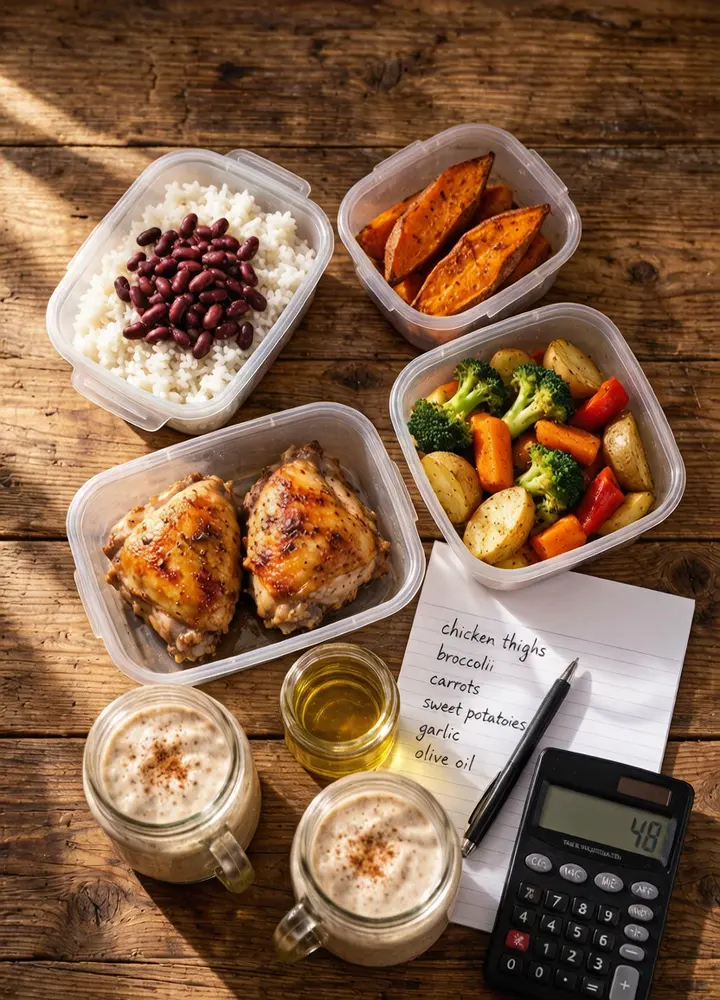
- Component prep: Cook proteins, grains, and veggies separately, then mix all week. This is the default recommendation — it's the easiest way to not quit from boredom.
- Ingredient prep: Just wash, chop, and portion raw stuff. Lightest lift, but you still cook daily, which is hard when you're tired after work.
Why it works for weight loss:
- Portions got decided once. On Sunday, not at 8 PM when you're starving. That one change ends most overeating.
- No 1 PM delivery-app scrolling. Lunch is already in the fridge, already paid for. The friction of ordering usually wins.
- No "hangry" grabs. When healthy food is the fastest option, chips lose.
- You control every ingredient. Restaurant meals hide 300-500 extra calories in oil, butter, and sugar. Your own pan doesn't.
2. What It Actually Costs: Tracking Templates
Does this actually work? Don't take anyone's word for it — including ours. Track your own numbers with the two templates below.
Your weight log (weigh at the same time of day, fill it in weekly):
| Week | Weight (lb) | Change | Notes |
|---|---|---|---|
| 0 | — | Starting point | |
| 1 | Usually the biggest drop — mostly water | ||
| 4 | First real trend line | ||
| 8 | Plateaus here are normal — adjust one lever | ||
| 12 | Twelve weeks is enough data to judge |
Time and money worksheet (fill in your own numbers for two weeks):
| Metric | Before prep | After prep |
|---|---|---|
| Sunday cook time (min) | ||
| Weekday cooking + deciding (min/day) | ||
| Groceries for 5 days ($) | ||
| Takeout runs per week |
Your numbers will look different — your TDEE, your prices, your schedule. That's exactly why you fill the tables in yourself. The shape usually holds, though: one focused block on Sunday buys back most of your weekdays.
3. The Only Tools You Actually Need
You do not need a $500 kitchen. Here's the short list that covers most of the job.
Containers
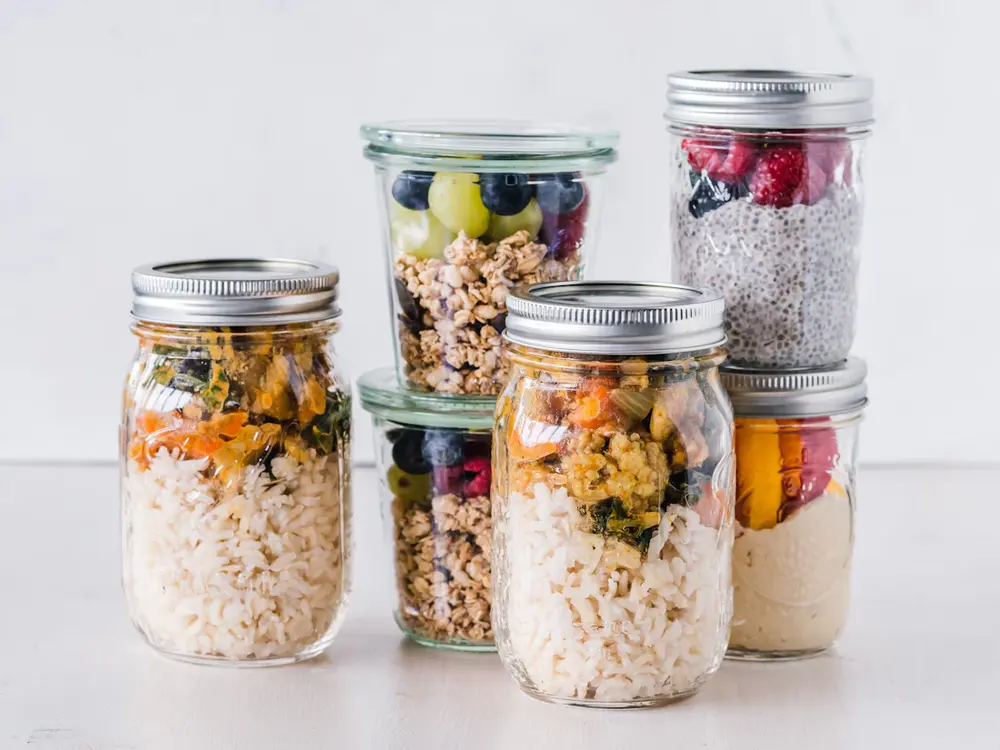
The one thing worth spending on. I use glass 3-compartment containers — they don't stain, they're microwave-safe, and they last for years. Bentgo and Rubbermaid Brilliance are the two I keep buying. Mason jars handle overnight oats and salads; silicone bags replaced Ziplocs for the freezer.
Kitchen basics
- One 8-inch chef's knife (a $20-25 one is fine)
- Two large sheet pans — I roast on all three racks sometimes
- One big pot for grains and soup
- A food scale — optional. You can start with hand-portioning and add one later
4. How to Plan Your First Week
Planning is most of the battle. A 3-step process:
Step 1: Count Real Meals
Be honest about your week. If you eat out Friday, don't prep Friday dinner — wasted food kills motivation in week one. A typical 5-day count:
- 5 breakfasts (Mon-Fri)
- 5 lunches (Mon-Fri)
- 4 dinners (Mon-Thu, if Friday is your eat-out night)
- 10 snacks (2 per day)
Step 2: Pick the Formula
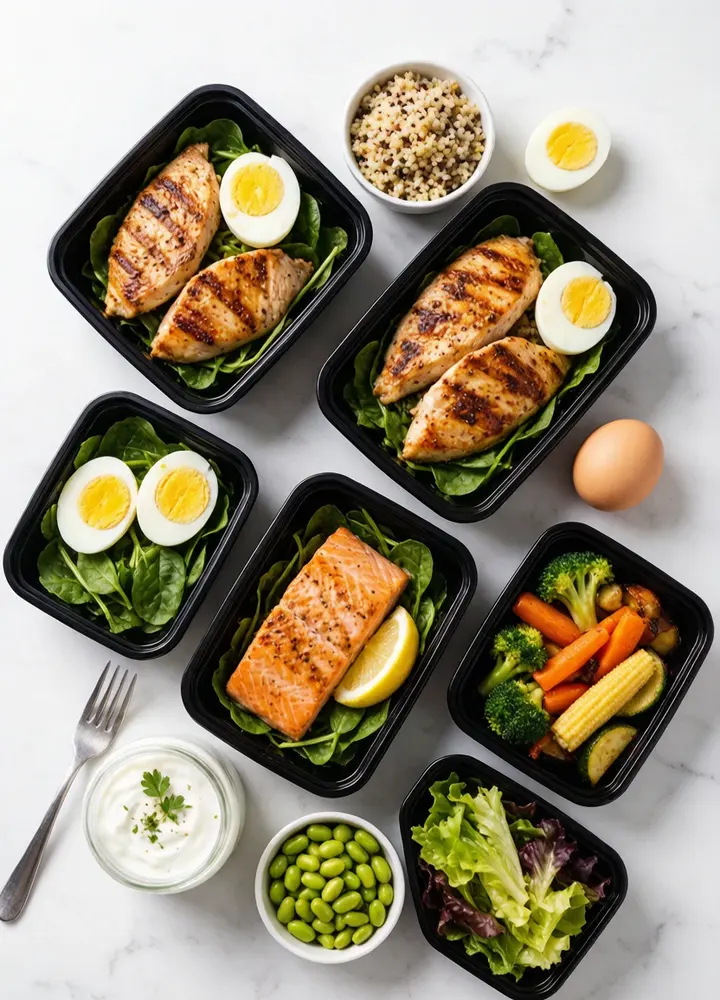
Every plate follows the same formula: Protein + Complex Carb + Vegetable + Healthy Fat. Keep 2-3 options in each lane and rotate:
- Proteins: Chicken breast, ground turkey, salmon, tofu, eggs, lentils
- Carbs: Brown rice, quinoa, sweet potato, whole wheat pasta, oats
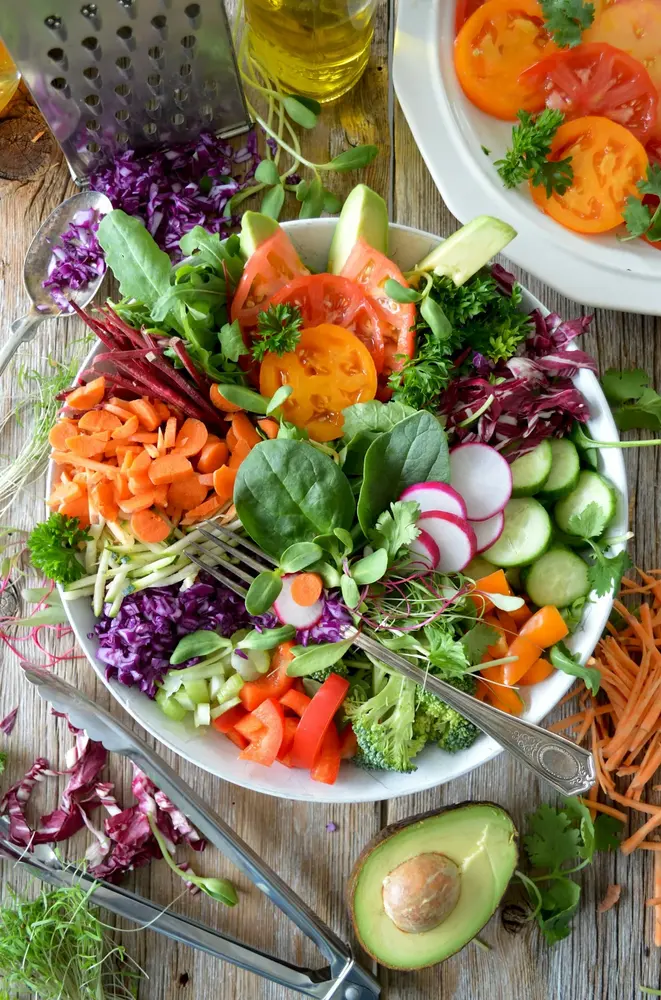
- Vegetables: Broccoli, bell peppers, spinach, zucchini, green beans, carrots
- Fats: Avocado, olive oil, nuts, seeds, cheese (sparingly)
Step 3: Pick a Prep Day
Sunday afternoon. Block 2 hours; the first session will run closer to 3 because the flow isn't automatic yet. It gets fast — most people settle in around 90 minutes with a podcast on.
5. A Starter Grocery List
Walk in with a list like this and stay on the perimeter (produce, meat, dairy). The middle aisles are where budgets double.
| Category | Buy These |
|---|---|
| Proteins | Chicken breast (2 lbs), eggs (1 dozen), Greek yogurt (32 oz tub), canned tuna (2 cans) |
| Grains | Brown rice, rolled oats, quinoa, whole wheat bread |
| Vegetables | Broccoli, spinach, bell peppers (3 colors), carrots, sweet potatoes (3), onions (2), garlic |
| Fruits | Bananas, apples, frozen berries (mixed) |
| Fats | Olive oil, almonds or walnuts, avocado (2) |
| Seasonings | Salt, black pepper, garlic powder, paprika, Italian seasoning, lemon juice |
Expected cost: $45-55 at a regular US supermarket for 5 days of meals for one person — if you stick to the list and skip the snack aisle. Prices vary a lot by region, so check your own receipts and fill in the worksheet above.
6. Batch Cooking: A Sunday Flow That Works
Here's a six-step order that works. The trick is oven math — everything finishes around the same time.
A 6-Step Prep Flow
- Grains first (0 min active). Brown rice or quinoa on the stove — longest cook. 1 cup dry = ~3 cups cooked, enough for the week.
- Oven to 400°F (200°C).
- Protein in (5 min active). 2 lbs chicken breast, salt/pepper/garlic powder/paprika, bake 22-25 min. Sweet potatoes cubed in oil on a second pan at the same time.
- Veggies in (10 min active). Broccoli, bell peppers, carrots on a third pan, oil + salt + pepper, 20 min.
- Cold items while it roasts (10 min). Wash spinach, overnight oats in jars, 6 hard-boiled eggs, nuts into snack bags.
- Assemble (15 min). 1 palm protein + 1 fist carb + 2 fists veg. Drizzle oil or light dressing — but keep dressing separate (see the mistake below).
7. Portion Control Without a Food Scale
You don't need a scale to start. Hands work — the same fist/palm/thumb estimates the Academy of Nutrition and Dietetics recommends:
- Protein: 1 palm (about 4-6 oz / 120-170g)
- Carbs: 1 cupped handful (about 1/2-3/4 cup cooked)
- Vegetables: 2 open handfuls (half your plate)
- Fats: 1 thumb (about 1 tbsp oil or 1/4 avocado)
That lands around 400-550 calories with balanced macros. If loss stalls for two weeks, trim the carb portion by a quarter and add vegetables — that's usually enough to get the scale moving again. Our free portion size converter turns these hand measures into grams and calories for the specific foods you prep.
8. How to Store Prepped Meals (and How Long They Last)
| Food | Fridge | Freezer | Notes |
|---|---|---|---|
| Cooked chicken/meat | 3-4 days | 2-6 months | Freeze in sauce so it doesn't dry |
| Cooked grains | 3-4 days | 1-2 months | Reheat with a splash of water |
| Roasted vegetables | 3-4 days | 2-3 months | Undercook slightly for reheating |
| Salads (assembled) | 2-3 days | Don't freeze | Dressing bottom, greens top |
| Hard-boiled eggs | 7 days | Don't freeze | Keep in shell until eating |
Data: USDA FoodSafety.gov — Cold Food Storage Chart
A good rule: anything you'll eat past day 3 goes in the freezer the moment you cook it, and moves to the fridge the night before. That one habit ends the "Thursday fridge smell" that pushes people back to takeout.
9. A Sample 5-Day Plan
A sample rotation showing how prepped components remix across a week. Macros are per day, averaged.
Monday
Breakfast: Overnight oats with Greek yogurt + berries (prepped Sunday)
Lunch: Baked chicken breast + quinoa + roasted broccoli
Dinner: Ground turkey stir-fry with bell peppers + brown rice
Snacks: Apple + 1 oz almonds | Hard-boiled egg
Kitchen note: Monday is the easiest day because everything's fresh. Eat the chicken first (it's the thing that goes) and save the grains for later in the week.
Tuesday
Breakfast: 2 scrambled eggs + whole wheat toast + 1/4 avocado
Lunch: Chicken + roasted sweet potato + spinach salad
Dinner: Baked salmon + quinoa + roasted asparagus
Snacks: Greek yogurt + berries | Carrot sticks + hummus
Kitchen note: Tuesday I swap the chicken for salmon at dinner — the omega-3 is the reason to pick it, and it breaks the "all chicken" boredom.
Wednesday
Breakfast: Overnight oats (day 2 of batch)
Lunch: Chicken + roasted veggies bowl with tahini drizzle
Dinner: Turkey lettuce wraps with brown rice + avocado
Snacks: Banana | Hard-boiled egg
Kitchen note: By Wednesday the overnight oats need help — switch from berries to a dash of cinnamon and a few walnuts so they don't taste like leftovers.
Thursday and Friday follow the same pattern — rotate the prepped components so no two lunches are identical. That variety is what keeps the habit alive.
10. 10 Common Mistakes to Avoid
- Prepping 7 days. Food goes sad by Thursday or Friday. Start with 3-4 days.
- No variety. Five identical bowls = quit by Friday. Different seasonings, swap one component.
- Dressing salads Sunday. Soggy by Tuesday. Pack dressing separate.
- Overcooking vegetables. They cook more when reheated — pull them a minute early.
- Skipping snacks. The 3 PM vending machine run quietly ends most attempts. Pre-portion nuts and fruit.
- No plan B. Frozen veggies and canned beans are the emergency backup. Always stocked.
- Wrong containers. Cheap containers pop open in the bag — lunch on the floor. Spend on locking lids.
- Forgetting breakfast. Overnight oats and egg muffins take 10 minutes for the whole week. Skipping them = drive-thru.
- Ignoring food safety. One tray left out too long can scramble the whole week. Cool, then fridge, immediately.
- Quitting after one bad week. Week one is messy. Week four is automatic. Give it a month.
11. Frequently Asked Questions
Is meal prep worth it if I live alone?
Yes — maybe more. Cooking for one, "I'll cook later" too easily becomes never. Prepping for one is smaller batches, same payoff. Freeze half so nothing wastes.
Do I need to meal prep every meal?
No. Prep lunches and breakfasts tight, keep dinners looser. Dinners are where most people want flexibility. Prep the meals you reliably fail at, not all of them.
What if I get bored of the food?
That's a prep-design problem, not a you problem. Keep three proteins and remix — chicken Tuesday, salmon Wednesday, turkey Thursday. Same 90 minutes, zero boredom. The full system is in the Guides.
Can meal prep actually save money?
Usually, yes — a $45-55 grocery list beats 4-5 takeout orders a week by a mile. The budget guide shows how to build a list that does it.
12. Your First Week: What to Do After
After week one, spend 5 minutes reflecting:
- What worked? Did you actually eat it? Which meal did you look forward to?
- What didn't? Something soggy? Not enough snacks? Bored?
- Adjust one thing. Swap a protein or a seasoning. Small tweaks compound.
Week 2 goal: Same meal count, one new recipe. Build consistency before complexity. That's the whole secret.
Ready to go deeper?
- 15 Easy Meal Prep Ideas for Weight Loss (Under 30 Minutes)
- Meal Prep Lunch Ideas for Weight Loss: 10 Filling Lunches
- Healthy Breakfast Meal Prep: 15 Make-Ahead Ideas
- Chicken Meal Prep: 10 Ways to Never Get Bored
- Meal Prep for Weight Loss on a Budget: $50/Week Grocery List
- Best Meal Prep Containers for Weight Loss in 2026 (Tested)
- 7-Day Meal Prep Plan for Weight Loss (Free Printable PDF)
- 10 Common Meal Prep Mistakes to Avoid
- Simple Meal Prep: 10 Recipes with 5 Ingredients or Less
- Low Carb Meal Prep for Weight Loss
Get the Free 7-Day Meal Prep Plan
Get the printable grocery list and Sunday prep schedule — everything from this guide in one PDF.
References
- National Institute of Diabetes and Digestive and Kidney Diseases (NIDDK) — Eating & Physical Activity to Lose or Maintain Weight
- Centers for Disease Control and Prevention (CDC) — Steps for Losing Weight
- Academy of Nutrition and Dietetics — Serving Size vs. Portion Size: Is There a Difference?
- USDA FoodSafety.gov — Cold Food Storage Chart