Prices are estimated US averages (Walmart, Aldi, and Kroger price levels). Check your own store's tags and pencil in your numbers.
The common trap: assuming "eating healthy" means a $140 Whole Foods run every Sunday — cold-pressed juice, organic kale, the works. Meanwhile, five takeout lunches a week at $12-15 each is roughly $300 a month, just for midday food.
The fix is turning Sunday night into prep night. The list in this guide comes in around $40, and the burrito bowls built from it are more filling than a $13 sandwich. That's the whole point — a concrete list with estimated prices, not a theory. If you're new to this, start with the beginner's guide first, then come back for the budget version.
| Metric | Estimate | Why it matters |
|---|---|---|
| Weekly grocery spend | $39-45 | The $50 list below, at typical store prices |
| Daily food cost | $5.50-6.50 | Breakfast + lunch + dinner + 2 snacks, all prepped |
| Typical takeout lunch | $12-15/day | The expense this plan replaces |
| Monthly savings | $150-250 | Swapping takeout for this plan |
| Weight loss pace | 1-2 lb/week | The CDC-endorsed sustainable pace, with a calorie deficit |
Table of Contents
1. The Budget Meal Prep Mindset
The budget meal prep mindset isn't a diet — it's cutting the three things that make "healthy" expensive:
- Convenience. Pre-cut vegetables, single-serve yogurt cups, "ready-to-eat" anything. You're paying for someone else's labor. Cut them and the bill drops on the spot.
- Branding. The organic label on a product that's nutritionally identical to its conventional counterpart. Store-brand oats have one ingredient: "rolled oats." Same as the name brand, 40% cheaper.
- Takeout and delivery. A $15 lunch five days a week is $300/month — more than this entire plan costs for a month. This is usually the single biggest leak.
The budget meal prep mindset is simple: buy whole ingredients, cook them yourself, and portion them out. You'll need a basic set of meal prep containers (a $15 10-pack lasts months) and a few kitchen staples. The switch from takeout lunches to budget prep typically frees up $200-400 a month — and you eat better, not worse.
2. Cheapest Protein Sources for Weight Loss
Protein is the most expensive macronutrient — and the most important for weight loss (it keeps you full and preserves muscle). Here's a ranked list of the cheapest protein sources per 30g serving:
| Protein Source | Cost per 30g Protein | Notes |
|---|---|---|
| Dried lentils | $0.25 | Cheapest protein period. Cook from dry. |
| Dried black beans | $0.30 | Also loaded with fiber. |
| Eggs | $0.50 | Price fluctuates — buy on sale. |
| Canned tuna | $0.70 | Limit to 2-3 cans/week (mercury). |
| Chicken thighs | $0.80 | Half the price of breast, more flavor. |
| Greek yogurt (bulk tub) | $0.85 | Buy 32 oz plain, not single-serve. |
| Ground turkey | $1.10 | Buy on sale and freeze. |
| Chicken breast | $1.50 | Stock up at $1.99/lb and freeze. |
3. The $50 Grocery List (Estimated Prices)
Prices below are typical estimates at Walmart, Aldi, and Kroger price levels — your store will vary. Treat the list as a template and pencil in your own store's numbers; the total should land between $40-50 almost anywhere in the US.
| Item | Quantity | Price |
|---|---|---|
| Proteins | ||
| Chicken thighs (bone-in, skin-on) | 2 lbs | $5.98 |
| Large eggs | 1 dozen | $3.49 |
| Plain Greek yogurt (32 oz tub) | 1 tub | $4.48 |
| Grains & Pantry | ||
| Brown rice (dry, 2 lb bag) | 1 bag | $1.48 |
| Rolled oats (18 oz canister) | 1 canister | $2.48 |
| Dried black beans (1 lb) | 1 bag | $1.42 |
| Vegetables & Fruits | ||
| Broccoli (1 head) | 1 head | $1.98 |
| Frozen mixed vegetables (16 oz) | 1 bag | $1.24 |
| Bell peppers (3-pack) | 1 pack | $2.98 |
| Baby spinach (10 oz bag) | 1 bag | $2.98 |
| Sweet potatoes | 3 medium | $2.37 |
| Bananas (1 bunch) | ~6 bananas | $1.38 |
| Frozen mixed berries (12 oz) | 1 bag | $2.98 |
| Onion + garlic | 1 onion + 1 head | $1.30 |
| Extras | ||
| Canned diced tomatoes (15 oz) | 2 cans | $1.96 |
| Lime | 2 limes | $0.66 |
| TOTAL | ≈$39 | |
Wait — under $40 at typical prices? Yes. The remaining $10-15 in your $50 budget covers pantry staples you probably already have (olive oil, salt, pepper, spices) and gives you room to add a few extras like cheese, avocado, or a bag of apples depending on what's on sale that week.
4. Where to Shop for the Best Prices
Not all grocery stores are created equal. Here's where to go for the best deals:
- Aldi: By far the cheapest for basics — eggs, dairy, produce, canned goods. You'll save 20-30% versus a regular supermarket. The trade-off: limited selection and you bag your own groceries.
- Walmart: Consistently low prices on pantry staples (rice, beans, oats) and frozen vegetables. Great for one-stop shopping if you don't have an Aldi nearby.
- Costco / Sam's Club: Worth it for bulk proteins (chicken, eggs, Greek yogurt) and frozen fruit — if you have storage space. The membership pays for itself in 2-3 months of meal prep savings.
- Ethnic markets (Hispanic, Asian, Middle Eastern): Often 30-50% cheaper on produce, spices, rice, and beans than mainstream supermarkets. Explore your local options.
- Farmers markets (end of day): Vendors often discount produce in the last hour. You can get $20 worth of vegetables for $10-12.
Avoid for budget meal prep: Whole Foods, specialty health food stores, and convenience stores (7-Eleven, CVS for groceries). You'll pay 40-80% more for the same items.
5. Sunday Prep Plan (90 Minutes)
Here's the exact flow for your Sunday prep session. Follow this order for maximum efficiency:
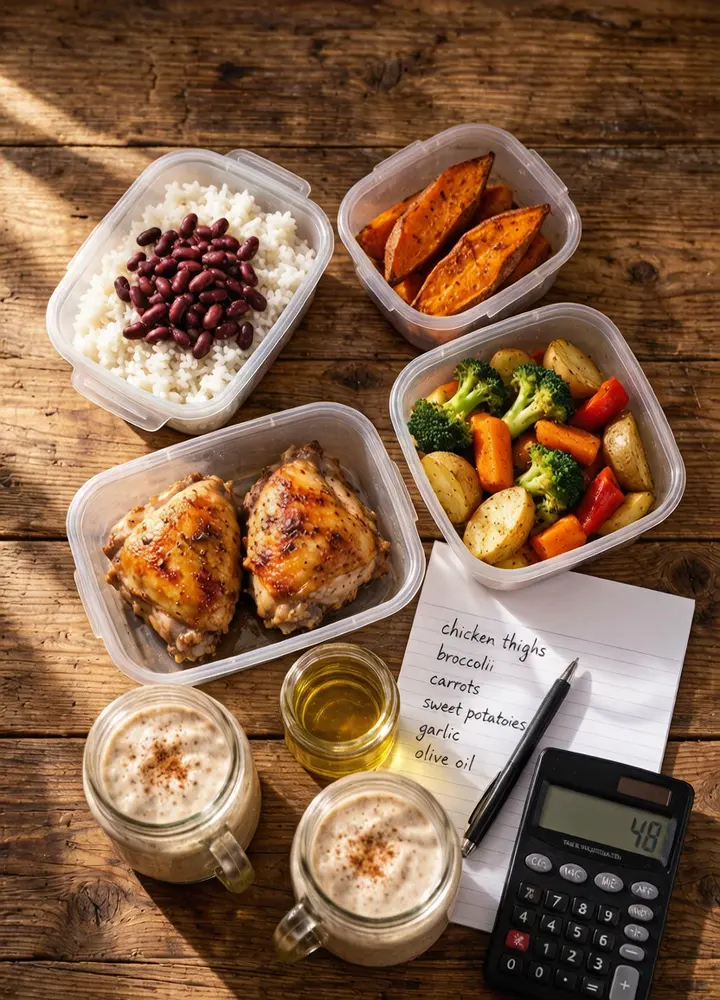
- Start the rice and beans (0 min). Put 2 cups brown rice + 4 cups water in a pot. Bring to a boil, reduce to simmer, cover for 40 minutes. If using dried beans, start those too (or use canned to save time).
- Preheat oven to 400 F.
- Prep the chicken (5 min). Season 2 lbs chicken thighs with salt, pepper, paprika, and garlic powder. Place skin-side up on a sheet pan.
- Prep sweet potatoes (5 min). Cube 3 sweet potatoes (no need to peel). Toss with 1 tbsp olive oil, salt, and pepper. Spread on a second sheet pan.
- Roast everything (35 min). Chicken and sweet potatoes go in together. Chicken is done at 35 min, sweet potatoes at 25 min. Check sweet potatoes with a fork — pull when tender.
- Chop vegetables (10 min). While everything roasts: cut broccoli into florets, slice bell peppers, dice onion. Toss broccoli and peppers with olive oil and salt.
- Start the eggs (5 min). Place 6 eggs in a pot, cover with cold water. Bring to a boil, then cover and remove from heat. Let sit 10 minutes, then transfer to ice water.
- Roast vegetables (18 min). After chicken and sweet potatoes come out, roast broccoli and peppers at 400 F for 18 minutes.
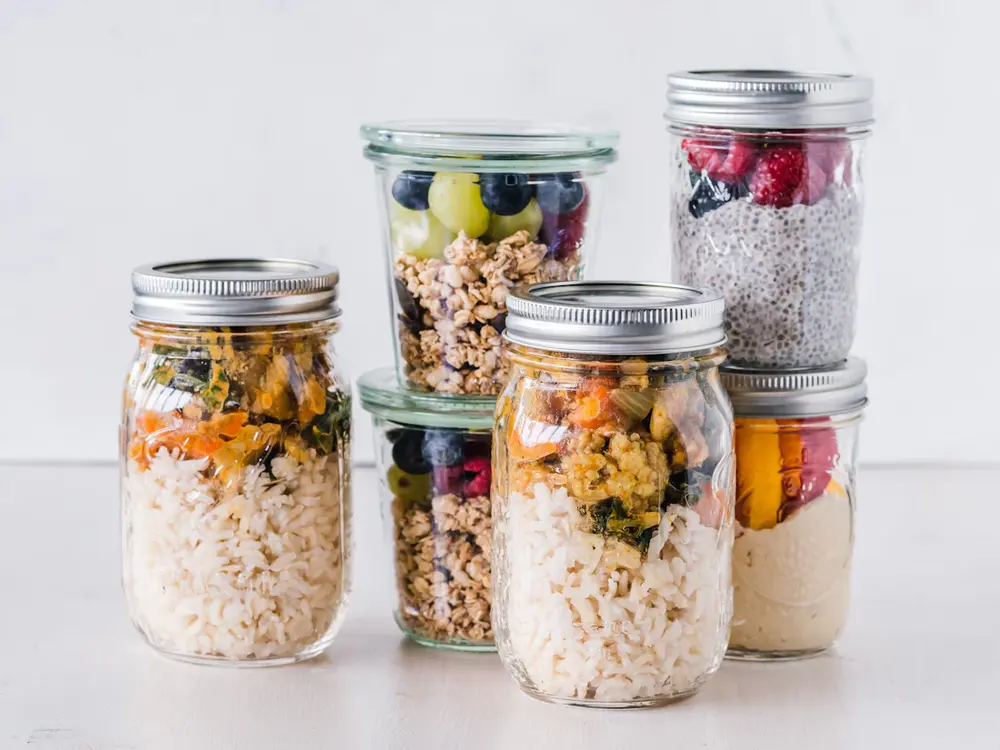
- Make overnight oats (5 min). In 5 mason jars: 1/2 cup oats + 1/2 cup water or milk + 1/4 cup Greek yogurt + 1/3 cup frozen berries per jar. Stir, seal, refrigerate.
- Cook black beans (if dried) or open cans (5 min). Season with cumin, garlic powder, and a pinch of salt.
- Shred the chicken (5 min). Once cooled slightly, remove skin and bones, shred the meat with two forks.
- Assemble containers (15 min). Portion everything into 5 lunch containers and 5 breakfast containers (see recipes below).
Total active time: ~55 minutes. Total elapsed time: ~90 minutes.
6. Five Days of Budget-Friendly Recipes
Breakfast: Overnight Oats with Greek Yogurt & Berries
5 jars, ~$0.90 each. Layer in a mason jar: 1/2 cup rolled oats, 1/2 cup water, 1/4 cup Greek yogurt, 1/3 cup frozen berries. Seal and refrigerate overnight. The berries thaw and create a natural sauce. Eat cold or microwave for 60 seconds.
Kitchen note: Stir the liquid and yogurt first, then fold in the oats — dumping dry oats on top leaves a dry clump at the bottom of the jar.
Lunch: Black Bean & Chicken Burrito Bowls
5 bowls, ~$1.80 each. In each container: 1/2 cup brown rice, 1/3 cup seasoned black beans, 4 oz shredded chicken, 1/2 cup roasted peppers, 2 tbsp diced tomatoes. Squeeze lime juice on top before eating. Optional: add a dollop of Greek yogurt as "sour cream."
Kitchen note: A spoon of Greek yogurt stands in for sour cream at about half the calories. The lime is non-negotiable; without it the bowl tastes flat by day three.
Dinner Options: Mix and Match
Make 5 different dinners by rotating your prepped components:
- Mon/Wed: Chicken + roasted broccoli + sweet potato (400 cal, 30g protein)
- Tue/Thu: Chicken + frozen mixed vegetables + rice with soy sauce (420 cal, 32g protein)
- Fri: Black bean soup: beans + diced tomatoes + sauteed onion, topped with a dollop of yogurt (380 cal, 22g protein)
Kitchen note: Cook the black beans Wednesday and freeze half. Friday's soup is then a 10-minute reheat — easy enough to actually happen instead of ordering pizza.
Snacks: Pre-Portioned for the Week
- Hard-boiled egg (70 cal, 6g protein) — $0.29 each
- Banana (105 cal) — $0.23 each
- Greek yogurt cup (1/2 cup) (70 cal, 12g protein) — $0.55 each
- Baby carrots or spinach handful (30 cal) — almost free
Kitchen note: Boil six eggs but only portion four into the week — by day five the yolks start to gray in the fridge. Eat the last two fresh; it keeps them out of the trash.
7. Cost Per Serving Breakdown
| Meal | Cost/Serving | Calories | Protein |
|---|---|---|---|
| Breakfast (overnight oats) | $0.92 | 340 | 18g |
| Lunch (burrito bowl) | $1.78 | 440 | 32g |
| Dinner (rotating options) | $1.95 | 400 | 30g |
| 2 snacks/day | $0.75 | ~300 | 15g |
| DAILY TOTAL | $5.40 | ~1,480 | ~95g |
Note: Daily calories shown are ~1,480, which is appropriate for a weight loss deficit for most women. Add an extra snack or increase portion sizes if you need more calories (men, athletes, or highly active individuals). The cost per day stays under $7 even with larger portions.
The table above is an example plan — for your own numbers, use our Meal Prep Cost Calculator: enter what you actually spent and how many servings you prepped, and it gives your true cost per meal plus savings against takeout.
8. Fifteen Money-Saving Meal Prep Tips
- Buy whole chickens instead of parts. A whole chicken is often $1.29/lb vs $3.99/lb for boneless breasts. Roast it, use the meat for 4-5 meals, then make stock from the carcass.
- Cook beans from dry. A 1 lb bag of dried black beans ($1.42) makes the equivalent of 4 cans ($3.92). That's 64% savings for 5 minutes of extra work (just soak overnight).
- Buy frozen vegetables. Frozen broccoli is $1.24 for 16 oz vs $1.98 for a fresh head. Nutrition is identical — frozen is flash-frozen at peak ripeness.
- Shop the "reduced" section. Most stores have a clearance shelf for produce and meat nearing its sell-by date. Use it that day or freeze immediately.
- Use a price book. Track the lowest price you've seen for your 10 most-bought items. When you see that price, stock up.
- Generic/store brand everything. The ingredient list for Great Value rolled oats is: "rolled oats." Same as Quaker, 40% cheaper.
- Embrace "ugly" produce. That crooked bell pepper tastes identical. Some stores (Misfits Market, Imperfect Foods) specialize in discounted ugly produce.
- Freeze bread and tortillas. They thaw perfectly. Never throw away half a loaf again.
- Batch cook grains for the month. Cook a large batch of rice, portion into freezer bags, and freeze flat. Reheats in 2 minutes.
- Use the whole vegetable. Broccoli stems are edible (peel and slice). Carrot tops make pesto. Onion skins and veggie scraps make stock.
- Water down your dressing. Mix 1 part vinaigrette with 1 part water or lemon juice. You'll use less dressing and save calories too.
- Oats are not just for breakfast. Use them as a binder in meatballs, a topping for fruit crisps, or blended into smoothies.
- Check unit prices, not sticker prices. The "$/oz" or "$/lb" on the shelf tag tells the real story. The bigger package is almost always cheaper per unit.
- Plan around what's on sale. Don't decide what to cook, then shop. Flip it: check the weekly ad, then plan your meals around what's discounted.
- Drink water before meals. It's free, fills you up, and most people mistake thirst for hunger. It won't replace a meal, but it'll stop you from overeating.
Frequently Asked Questions
Can you really meal prep for weight loss on $50 a week?
Yes — the list below comes in around $39-45 at typical Walmart/Aldi/Kroger price levels, before pantry staples you probably already own (olive oil, salt, pepper, spices). The real trick isn't coupons — it's stopping the $12-15 takeout lunches. Once you cook chicken thighs, beans, and rice in bulk, five days of portion-controlled meals run about $5.50 a day. Plan your list around what's on sale and skip pre-cut, pre-packaged convenience items — that's where the budget leaks.
What are the cheapest protein sources for meal prep?
Ranked by cost per 30g of protein: dried lentils (~$0.25), dried black beans (~$0.30), eggs (~$0.50), canned tuna (~$0.70, limit to 2-3 cans a week for mercury), chicken thighs (~$0.80), bulk-tub Greek yogurt (~$0.85), and ground turkey on sale (~$1.10). Chicken breast and salmon run 2-3x the price — grab them only when marked down. Thighs are the budget workhorse: half the cost of breast, more flavor, and the skin keeps the meat juicy until you pull it off before eating.
How do I save money on vegetables for meal prep?
Buy frozen (broccoli, mixed veg, spinach run $1-2 a bag and the nutrition is identical to fresh because they're flash-frozen at peak ripeness), shop the reduced produce shelf at the end of the day, hit Aldi or an ethnic market where the same pepper costs 30-50% less, and buy whole vegetables instead of pre-cut. Treat frozen as the default instead of a backup and produce waste drops to almost zero.
What does the first budget week actually cost?
Plan on $55-60 if you're starting from scratch — olive oil, cumin, and a $15 set of containers add up on top of the grocery list. By week two, with staples in the pantry, you're back in the $39-45 range. The setup pays for itself within the first week versus takeout. If you're starting empty, budget an extra $10-15 the first week and it drops after that.
Ready to keep going?
- How to Start Meal Prep for Weight Loss: The Complete Beginner's Guide
- 15 Easy Meal Prep Ideas for Weight Loss (All Under 30 Minutes)
- How to Portion Control for Weight Loss: The Complete Guide
- Best Meal Prep Containers for Weight Loss in 2026
- How Long Does Meal Prep Last? Complete Storage Guide
- Vegetarian Meal Prep for Weight Loss
Get the Free 7-Day Budget Meal Plan
Includes the complete $50 grocery list, Sunday prep schedule, and 21 recipes with macros.