The thing that finally made weight loss stick for me wasn't a diet — it was learning to eyeball a portion. For two years I'd open MyFitnessPal, log three bites, give up by Wednesday, and wonder why the scale never moved. I didn't have a willpower problem. I had no idea what a "normal" amount of rice actually looked like.
So I stopped counting and started using my hands. My palms, my fists, my thumbs. No scale, no app, no math. Within about four months the weight came off and — more importantly — it stayed off, because I'd actually learned the skill instead of renting it from a database.
This guide covers three methods, from zero equipment to using a food scale if you want precision. Pick the one that fits your personality.
Table of Contents
- Why Portion Control Beats Calorie Counting
- Method 1: The Hand Method (No Tools Required)
- Method 2: Visual Comparisons
- Method 3: The Plate Method
- Bonus: How to Use a Food Scale (If You Want Precision)
- Portion Size Reference Chart
- How to Adjust Portions When You're Not Losing Weight
- Common Portion Control Questions
1. Why Portion Control Beats Calorie Counting
Calorie counting works — mathematically. But it failed me psychologically, and it fails most people the same way. Here's why I ditched it:
- It's exhausting. Logging every almond and drizzle of olive oil turns eating into a data entry job. I quit within 3 weeks every single time.
- It's inaccurate. Studies show people underestimate calories by 20-40% — even trained dietitians. Nutrition labels can be off by up to 20%. So the "precise" number you're chasing isn't precise anyway.
- It teaches you nothing. After 6 months of MyFitnessPal, can you eyeball a proper portion of rice? I couldn't — because the app did the thinking for me, and the day I deleted it I was back to square one.
Portion control, by contrast, teaches you a skill. Once you learn what a proper portion looks like, you don't need an app. You can eat at a restaurant, a friend's house, or a work event and still make good choices. You're not dependent on a database.
| My Portion Control Numbers | Before (eyeballing) | After (hand method) |
|---|---|---|
| Lunch calories | ~750 (restaurant, no idea) | ~480 (homemade, palm-built) |
| Daily protein | ~70 g (inconsistent) | ~150 g (1 palm × 3 meals) |
| Weight trend | flat for 3 months | -42 lb / 4.5 months |
| Tools used | phone + app, daily | my hands, zero |
| Time spent | ~10 min logging/day | none |
2. Method 1: The Hand Method (No Tools Required)
This is the method I teach everyone, because it's the one I actually use. Your hands are proportional to your body size — a 6'4" man has bigger hands than a 5'2" woman, so his portions scale automatically. No math, no conversion chart.
How to Build a Portion-Controlled Plate Using Your Hands
- Protein = 1 palm (thickness and diameter of your palm, excluding fingers)
Examples: chicken breast, fish fillet, tofu block, 2 eggs
~4-6 oz / 25-35g protein / 150-250 calories - Carbohydrates = 1 cupped handful (make a cup with your hand)
Examples: rice, pasta, potatoes, oats, beans
~1/2-3/4 cup cooked / 30-45g carbs / 150-200 calories - Vegetables = 2 open handfuls (both hands open, palms up)
Examples: broccoli, spinach, bell peppers, carrots, salad greens
~1.5-2 cups / 25-50 calories (negligible for weight loss) - Fats = 1 thumb (length and width of your thumb, from knuckle to tip)
Examples: olive oil, butter, nut butter, cheese, avocado
~1 tbsp / 12-15g fat / 100-130 calories
Hand-portion guidance: Academy of Nutrition and Dietetics — Serving Size vs. Portion Size (fist = 1 cup, palm = 3 oz protein, thumb = 1 tbsp fat)
Kitchen note: I'm 5'5" with medium hands, and one palm of chicken runs about 5 oz — right in that 4-6 range. When I started I'd over-serve myself to a full hand including fingers, which is closer to 8 oz and ~400 calories of protein alone. Excluding the fingers was the single fix that brought my dinners back under 550.
That's it. A meal built this way lands between 400-550 calories with balanced macros. If you eat 3 meals + 2 snacks per day using this method, you'll hit roughly 1,500-1,900 calories — a solid weight loss zone for most people.
Snack Portions (Hand Method)
- 1 protein-rich snack: 1/2 palm of protein or 1 small Greek yogurt (100-150 cal)
- 1 fruit/veg snack: 1 fist-sized fruit or 2 handfuls of veggies (50-100 cal)
3. Method 2: Visual Comparisons
If you prefer thinking in objects rather than body parts, use these everyday comparisons. I still catch myself using these at restaurants when my hands are full of cutlery.
| Food | Correct Portion | Looks Like |
|---|---|---|
| Chicken breast | 4 oz (113g) | Deck of cards |
| Fish fillet | 5 oz (140g) | Checkbook |
| Cooked rice or pasta | 1/2 cup | Tennis ball |
| Potato or sweet potato | 1 medium | Computer mouse |
| Cheese | 1 oz (28g) | Pair of dice or your thumb |
| Nut butter | 1 tbsp | Golf ball or your thumb |
| Nuts | 1 oz (28g) | One shot glass or small handful |
| Oil or dressing | 1 tbsp | Thumb tip to first knuckle |
| Avocado | 1/4 medium | 2 tbsp (small scoop) |
| Ice cream (treat) | 1/2 cup | Tennis ball |
Kitchen note: The "tennis ball = 1/2 cup rice" one saved me at Chipotle. I used to get a full burrito bowl and eat it all standing up. Now I scoop the rice into roughly a tennis ball and suddenly half the bowl is protein and veggies. Same bowl, ~300 fewer calories, and I'm not stuffed.
4. Method 3: The Plate Method
The plate method is perfect for visual thinkers. Divide your plate into sections:
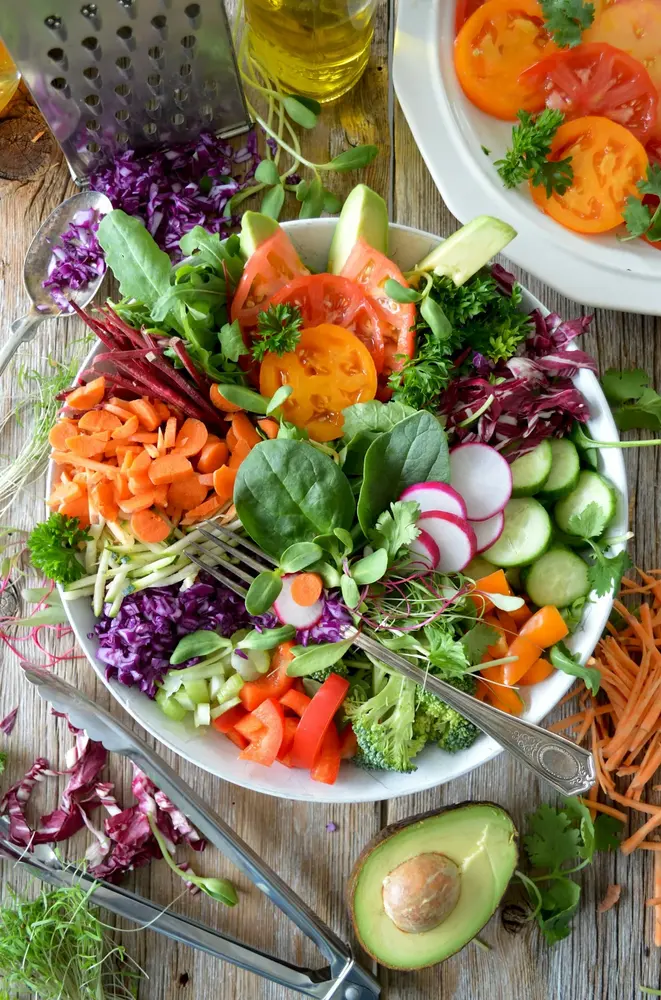
- 1/2 plate = vegetables (non-starchy: greens, broccoli, peppers, cauliflower, zucchini)
- 1/4 plate = protein (chicken, fish, tofu, eggs, lean meat)
- 1/4 plate = complex carbs (brown rice, quinoa, sweet potato, whole wheat pasta, beans)
- Small amount of healthy fat drizzled on top or on the side (olive oil, avocado, nuts)
This works regardless of plate size — the ratios stay the same. On a smaller plate (9-inch vs 12-inch), you automatically eat less without feeling deprived. This is called the "small plate trick" and it has real research behind it: people who use 9-inch plates eat ~22% fewer calories without noticing, according to a Cornell University study.
Kitchen note: I swapped my 12-inch dinner plates for 9-inch ones and didn't change a thing about what I ate — just the plate. Dinner went from ~620 to ~500 calories just from the smaller surface. That 22% figure isn't marketing, it showed up on my scale. The plates cost me $18 at a thrift store.
5. Bonus: How to Use a Food Scale (If You Want Precision)
If you're the type who likes exact numbers, or you've hit a weight loss plateau, a food scale can help. But use it as a calibration tool, not a lifetime commitment.
The 2-Week Calibration Method
- Week 1: Weigh everything you eat. Log it (or just mentally note it). The goal isn't restriction — it's awareness.
- Week 2: Before weighing, guess the weight. Then weigh and see how close you were. You'll be surprised how fast you calibrate.
- Week 3+: Put the scale away. Use your newly trained eye. Bring it out once a month to check yourself.
Kitchen note: I bought a $12 digital scale two years in, during a three-week stall. Week 1 I guessed my "palm" of chicken at 5 oz — it was actually 8.5. My "thumb" of olive oil was closer to 2 tablespoons. Doing the guess-then-weigh drill for two weeks pulled my eye from ±40% error to about ±10%, and I haven't touched the scale since. It lives in a drawer now.
If you want a food scale, here are some that don't break the bank: Amazon Basics Digital Kitchen Scale ($10-12) or OXO Good Grips Scale ($30, pull-out display for large bowls).
6. Portion Size Reference Chart
Print this or screenshot it. Stick it on your fridge.
| Food Group | Portion = | ~Calories |
|---|---|---|
| Lean protein (chicken, fish, tofu) | Palm size, 4-6 oz | 150-250 |
| Fatty protein (salmon, steak, thighs) | Palm size, 4-6 oz | 250-350 |
| Grains (rice, pasta, quinoa) | Cupped handful, 1/2-3/4 cup cooked | 150-200 |
| Starchy veg (potato, corn, peas) | Fist size | 100-150 |
| Non-starchy veg (broccoli, greens) | 2 open handfuls, unlimited | 25-50 |
| Fruit | 1 fist-sized piece or 1 cup berries | 60-100 |
| Fats (oil, butter, nuts, cheese) | Thumb size, 1 tbsp | 100-130 |
| Legumes (beans, lentils, chickpeas) | 1/2 cup cooked | 110-130 |
7. How to Adjust Portions When You're Not Losing Weight
You've been portion-controlling for 2 weeks. The scale hasn't moved. Don't panic — don't slash calories. Make one small adjustment at a time.
A healthy pace is roughly 1-2 pounds per week, the rate the CDC associates with keeping weight off long term. If you're in that range, stay the course. If you're below it after two consistent weeks, try the levels below — one at a time.
The Tiered Adjustment System
Level 1: Carb Reduction
Reduce your carb portion from 1 cupped handful to 3/4 handful. Increase vegetables to fill the gap on your plate. This cuts ~100 calories per meal without triggering hunger. Wait 2 weeks before adjusting further.
Level 2: Fat Awareness
Are you eyeballing oil or measuring it? A "drizzle" of olive oil is often 2-3 tablespoons (240-360 calories) when you think it's 1. Use a measured 1 tbsp or switch to an oil spray. Also check: are you snacking on nuts mindlessly? A "handful" of almonds can be 300+ calories.
Level 3: Liquid Calories
Cut one caloric drink per day. A daily latte (190 cal), soda (150 cal), or glass of wine (125 cal) adds up to 875-1,330 calories per week — that's 1/3 to 1/2 pound of fat worth of calories. Switch to black coffee, sparkling water, or skip the alcohol on weeknights.
Level 4: Meal Timing
Try eating your last meal 3 hours before bed. Late-night eating is less about the calories and more about the type of food people eat late at night (chips, ice cream, leftovers). A hard cutoff reduces mindless eating by ~250 calories/day in most people.
Kitchen note: My first stall came at week six. I didn't crash-diet — I just dropped my rice from a full handful to 3/4 and piled on more broccoli. Two weeks later the scale moved again. The lesson that stuck: change ONE lever, wait two weeks, read the result. When I tried changing carbs, fats, and bedtime all at once, I couldn't tell which one did anything.
8. Common Portion Control Questions
Do I have to portion control vegetables?
No. Non-starchy vegetables (broccoli, spinach, peppers, cucumbers, zucchini, etc.) are so low in calories that it's almost impossible to overeat them. A full pound of broccoli is ~150 calories. Eat as many as you want. The only vegetables to watch are starchy ones: potatoes, corn, peas, and winter squash — these count as carbs. I keep a bag of pre-washed broccoli florets in the fridge and go back for seconds whenever a meal leaves me wanting more.
What about sauce and condiments?
Sauces are portion control killers. A "normal" pour of ranch dressing is 3-4 tbsp (200-270 calories), but the serving size is 2 tbsp (130 cal). Ketchup and mustard are fine (low cal). BBQ sauce and mayo add up fast. My fix: I put sauce in a small dish on the side and dip my fork in, then pick up food — I use about a third as much and still taste it.
How do I portion control at restaurants?
Restaurant meals are 2-3x normal portions. Three strategies that worked for me: (1) Ask for a to-go box when my food arrives and box half immediately — before I take a bite, so I don't "just finish this part." (2) Order an appetizer + side salad as my meal. (3) Split an entree with whoever I'm with. And restaurants pour 3-4 tbsp of oil on everything, so I always ask for dressing or sauce on the side.
What if I'm still hungry after my portion?
Eat more vegetables. If you finished your plate and you're genuinely hungry (not bored, not stressed, not thirsty), go back for a second helping of vegetables only. If you're not hungry enough for broccoli, you're not actually hungry — you just want more of the tasty stuff. This test has never lied to me.
Ready to put this into practice?
- How to Start Meal Prep for Weight Loss: The Complete Beginner's Guide
- 15 Easy Meal Prep Ideas for Weight Loss
- Meal Prep for Weight Loss on a Budget: $50/Week
- 7-Day Meal Prep Plan for Weight Loss
- High Protein Meal Prep: 10 Recipes with 30g+ Protein
Get the Free Portion Control Cheat Sheet
One-page printable PDF with the hand method, visual guide, and portion chart. Stick it on your fridge and never guess again. Join 5,000+ subscribers.
References
- Academy of Nutrition and Dietetics — Serving Size vs. Portion Size: Is There a Difference?
- Centers for Disease Control and Prevention — Diabetes Meal Planning (Plate Method)
- Centers for Disease Control and Prevention — Steps for Losing Weight